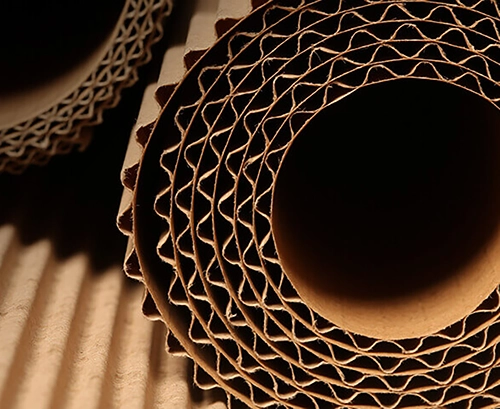
The primary material used in various types of cardboard and boxes is fluting paper, commonly referred to as corrugated paper due to its distinctive corrugated structure. In fact, all cardboard products contain at least one layer of this type of paper. Fluting paper, characterized by its thick and durable composition, serves as the middle layer in cardboard sheets.
Fluting paper is produced using wood pulp and agricultural waste, such as bagasse, similar to other types of paper. It’s important to highlight that the production of corrugated paper typically involves the use of cardboard, recycled papers, and second-hand fibers. This approach not only reduces costs but also significantly minimizes environmental impact.making it an eco-friendly and sustainable choice for packaging industries.
Fluting cardboard comes in various sizes and types, each with different applications and characteristics. The production of corrugated paper with a weight of 120 to 180 grams per square meter and widths of 100 to 240 centimeters is done according to customer orders. In general, larger corrugations (A and B profiles) result in higher strength and better impact resistance. Smaller corrugations (E and D profiles) in fluting paper allow for better printing and foldability.
– Fluting A: This type has fewer corrugations compared to other fluting papers, but it has a greater height. There are approximately 36 corrugations per foot (about 30 centimeters). Fluting A can be used as a double-layer or a thick corrugated protective layer.
– Fluting B: This paper also has a high height and a lower number of corrugations. There are approximately 49 corrugations per foot. Due to its high strength and resistance to breaking, it is used as impact resistance. It is also suitable for packaging food items in the retail industry.
– Fluting C: One of the most common types of fluting used in cardboard production. There are 41 corrugations per foot. Its excellent impact resistance, good printing, and flexibility make it suitable for the production of common cardboard in the transportation industry and household goods boxes.
– Fluting E: Fluting type “E” is popular in the Iranian market. Its corrugated structure is finer than other models, with about 90 corrugations per foot and a slightly lower height. It offers more flexibility and is suitable for printing. Most cardboard sheets are of the E fluting type.
– Fluting F: Paper F fluting has the smallest corrugations, making it a small and sturdy choice for making foldable cardboard. There are approximately 128 corrugations per foot, and the produced sheets are very strong.
Exim Paper Trading L.L.C has identified the unique packaging needs of various industries. To address these needs, we offer a wide range of options for fluting paper. These options include various weights and sizes, allowing different industries to package their products uniquely using suitable fluting paper.
The manufacturing of fluting paper typically occurs in integrated pulp and paper mills where the pulp is produced on-site and directly fed into the paper machine. The production process involves several key steps:
Cutting and Finishing: The final product is rolled, cut into sheets or rolls, and prepared for shipment
Fluting paper is primarily used in the production of:
Fluting paper strengthens cardboard and packaging boxes. In fact, without fluting paper, we would not have any effective shock absorber or suitable box. Whether we are purchasing cardboard for moving or packaging electrical appliances, food, and sanitary items, all these items ultimately require a sturdy box that does not deform easily and is not easily torn.
The corrugated structure of fluting paper prevents the pressure from being transferred to the inner layers, resulting in thick and sturdy cardboards with fewer layers. Additionally, the weave of fluting paper allows it to easily bend, taking various shapes and facilitating easy storage.